EASY Joint Original FAQs
Installation
The paving joint needs to be a minimum of 3mm wide, (what is described as a narrow paving joint) however care should be taken measuring this as with some, chamfered edge ‘V’ shaped paving, the joints at the bottom edge can be narrower than the top. EASYJoint is designed to be a narrow joint filler and is probably the best on the market. Note there is no maximum paving joint width, feel free to use as much EASYJoint as you like!
Not really, but depth must be at least 20mm.
NO, the wetter the better. Water does two main jobs. It helps reduce any residue staining and the water moves the compound easier into the joints, filling all the cavity.
Yes, this is actually a bonus. Wetter the better!
This depends on the joint dimensions. See the online calculators to work out how much you will need for your project.
Yes, providing the paving has been laid on a permeable base in accordance with the instructions for use.
Yes, very. Surface water that enters the joint will pass down. It will also pass back up the joint which can lead to other issues. See next sections.
No. Block paved drives are laid so close that the joint gap is less than 3mm in most cases. The other reason why EASYJoint is not suitable is that most block paved drive installations are what’s known as unbound. This means that the blocks are not fixed into mortar and can slightly move when driven on. This is enough movement to cause blocks to rub and this will break up the jointing compound.
Some concrete paving is made in moulds and has chamfered edges creating a ‘V’ shaped joint between two paving slabs, wider at the top than at the bottom. This gap shape can be the most challenging to work with and we recommend you carefully follow the instructions below.
Maintain the Width of Joint Throughout. Maintain at least a 3mm gap width throughout the depth of the paving material. Never have this type of paving butted together. See photograph.
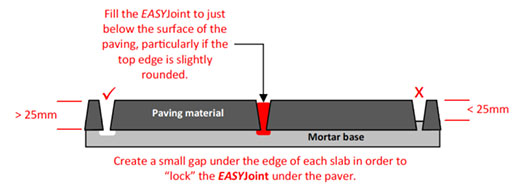
Lock in the Joint. An irregular “V” shaped joint means that any type of filler will have difficulty staying in place. To assist in forming a stable joint when laying the paving, draw the tip of your trowel along the bottom edge of each slab so that a small gap forms along and under the paving edge. EASYJoint will flow into the gap and when set will be locked into place. See diagram below.
To further aid this, “point” or “strike” the joint; do not leave it textured. This ensures the top of the filler is below the top rounded edge of the paving and helps it adhere to the base and sides of the paving material.
Do not overfill the Joint As with all types of paving, never overfill the joint. This is particularly important if the paving has a “rounded” top edge. The filler should be kept below the start of the “rounding”. See diagram below.
IMPORTANT NOTE: You should not use EASYJoint to re-point a patio with this type of joint. Contact us for more help.
The answer to this is twofold really. EASYJoint ORIGINAL & SELECT are air curing products.
The warmer and drier the air, the quicker the compound will cure. As an opposite, the colder and wetter the air, the longer it will take for the compound to cure. It would not be uncommon for curing times to be extended by 7-10 days in winter due to the dampness in the air.
The prolonged curing is not an issue; however, the compound could be weakened during this time if there are constant rain showers. This washing process will eventually weaken the hardeners rendering them useless. It is recommended that areas are covered and protected if rain is forecast over a long period.
Ongoing product development has proven that it is preferable to point or iron a joint filled with a sweep-in air-curing sand as this increases strength, durability and speeds up curing times.
It is the installers responsibility to understand the nature of the product and its limitations.
Troubleshooting
It helps reduce any residue staining.
This is most likely oil residue from the compound which was not washed from the surface. Don’t panic though, these marks fade away quite quickly.
This is one of the binders which has a distinctive smell. It becomes unnoticeable after a few days when outside. If used inside, it may take longer to go. Ensure any indoor use is well ventilated.
This occurrence is mainly due to the compound not curing properly after installation which is attributed to a patio base-mix which is not free-draining. This poor drainage causes a wet/dry/wet situation which weakens the hardening agents in the compound. It is also a sign that the finished joint was not ironed (pointed) and was left in a rough, swept-in state. Ironing the joint ensures better compaction which in turn gives increased strength.
This happens because the paving joint has not been cleared out to the correct depth as the paving was laid. The remedy to this is to grind out the exposed mortar to achieve a minimum depth of 20mm before replacing the section with fresh EASYJoint.
If used correctly, the product will perform as intended. We cannot guarantee the product completely due to the various installation techniques and site conditions.
This is an algae build-up. This usually occurs on joints that rarely dry out or are in shade most of the day.
Red joints are due to a form of algae that sits on the surface of the joint. This can be treated with Azpects Algae Cleaner & Remover.
White joints are usually due to an efflorescence build-up on the surface. This generally is a result of a bedding mortar which is stronger than 6:1, therefore less permeable. Surface water enters the joints, hits the fresh mortar and washes back up through the joint bringing calcium and lime deposits from the mortar. This can be cleaned with EASY Mortar Stain & Calcium Remover if the paving is suitable.
Black joints are usually attributed to an algae growth, but they can be dark just because the joints are saturated. Algae Cleaner & Remover ‘may’ clean them, but this may require further investigation.
Drainage. When the patio base mix is of a stronger mix, 4:1 is common, the water in the joint cannot drain away and this water keeps the compound from curing. It may also be just because it has rained a lot after installation. If the drainage is good, the joints should cure when they dry out.
Yes, you can continue to use EASYJoint throughout Winter. Just be mindful that less water is required and be aware that paving may become slippery in freezing conditions. It is also important to check that there is no ice formed at the base of the joint. When this thaws, it will leave a void which may show by the compound dropping.
No, it is best to replace a section as new EASYJoint will not adhere to some that has already cured.
This is down to a slight settlement of the paving area. EASYJoint does not shrink or change shape, but the paving area has been made up and may see some settlement in its early days. The best option is to remove those areas with cracks and replace with fresh EASYJoint. Early settlement usually only happens once whilst the area settles.
General
See our website Stockist Locator
EASYJoint can be stored inside or outside without any problems. Prolonged exposure to sunlight may fade tubs. It is advisable to avoid storing inside metal shipping containers in particularly hot weather unless they are well ventilated.
Unused, but open bags of EASYJoint ORIGINAL & SELECT can be stored for later use simply by emptying the bag into a clean empty tub and filling it with water, making sure the sand is covered by at least 50mm, thus preventing air to cure the sand. A crust may develop which should be discarded before using the wet sand. In some cases, a black mould may appear on the tub lid which should be treated as hazardous and dealt with as you would with mould, say, in a bathroom
Yes, you can as it doesn’t affect how the product works. Remember to mix equal quantities each time or risk having different shades.
The product is not considered harmful to aquatic organisms nor to cause long-term effects in the environment-however, it is advisable to prevent any compound spilling into ornamental fishponds.
It is advisable to keep pets off the jointed area until it has cured.
Yes, although this will make the joint less permeable.


